Showing posts with label Honda Cars. Show all posts

Sunday, January 16, 2011

2011 Honda Accord Coupe

2011 Honda Accord Coupe

For 2011, the Honda Accord receives the first significant updates for its current-generation platform. Most notably, fuel economy is up thanks to revised aerodynamics plus tweaks to the engines and transmissions. The SE trim level has been added and there are new optional features as well, including an iPod/USB interface, a rearview camera, driver memory functions and shift paddles. The exterior has been given a mild refresh, while the interior's climate-control buttons have been rearranged for compatibility with the optional navigation system.

What midsize sedan should I buy?" The answer to this question has long been "Honda Accord." It's the instinctive response, like being asked your birthday or your dog's name. The Accord has been a top choice in the segment so consistently that recommending one has always been easy. Times are changing, however. With impressive new competitors, the 2011 Honda Accord now has more serious rivals to compete against.

The current-generation Accord (it debuted in 2008) is the biggest yet, offering the most accommodating interior in its class. Yet this super-sizing of the Accord also comes with a downside, because it no longer feels like the "right-size" choice in the family sedan class. While its steering remains responsive and tactile, the Accord has a tendency to feel super-sized when driven around corners. Its acceleration is also a bit underwhelming, with a five-speed automatic transmission doing duty here when most competing models now offer snappier six-speeds. 

There is one bright spot for 2011, because the Accord's engines choices are now more frugal. Thanks to aerodynamic tweaks, engine friction reductions and revised transmission gearing, the four-cylinder Accord now has an EPA rating of 23 city/34 highway, a rise of about 2 mpg that takes the Accord to the top of the fuel economy chart for family sedans. The V6 is also a bit more efficient this year, too.

Unfortunately, the Accord's interior hasn't changed much for 2011. Compared to newer competitors like the Ford Fusion, Hyundai Sonata and Kia Optima, the Accord's cabin looks and feels a bit down-market. The plastics aren't as nice and the look is rather drab -- especially if you opt for gray. Honda has made some slight changes to the convoluted climate controls found on navigation-equipped models this year, but the Accord's center stack continues to be plagued by far too many buttons. 

Nevertheless, it's important to note that the 2011 Honda Accord remains a solid pick among family sedans. It's spacious, fuel-efficient and reliable and should hold its value well. The Accord also comes in a sporty coupe body style, something that few other automakers offer in their midsize models. So we still recommend the Accord. But choices like the Fusion, Optima, Sonata, Mazda 6 and even the Suzuki Kizashi now outpace the Accord in many areas, so the answer to "What midsize sedan should I buy?" is now more muddled than it used to be.

2011 Honda Accord is available as a midsize sedan and coupe. The sedan comes in LX, LX-P, SE, EX and EX-L trim levels, while the coupe comes in LX-S, EX and EX-L trims.

The base LX trim comes equipped with 16-inch steel wheels, keyless entry, full power accessories, air-conditioning, cruise control, a tilt-and-telescoping steering wheel, a height-adjustable manual driver seat and a six-speaker sound system with CD player and an auxiliary audio jack. The LX-P trim adds 16-inch alloy wheels and an eight-way power driver seat. The SE adds leather upholstery, a leather-wrapped steering wheel, power-adjustable driver lumbar and heated front seats. The EX adds or supplants LX-P equipment with 17-inch alloys, a more powerful four-cylinder engine, a sunroof, heated mirrors, power-adjustable driver lumbar, upgraded interior trim, a six-CD changer and a USB audio jack. 

The EX-L adds automatic headlights, dual-zone automatic climate control, heated front seats, leather upholstery, a leather-wrapped steering wheel, an auto-dimming rearview mirror, Bluetooth, a seven-speaker upgraded sound system, satellite radio and the option of a navigation system with voice control and a rearview camera. A V6-equipped EX-L also gains driver seat memory settings and a four-way power passenger seat.

The coupe's LX-S trim is equipped similarly to the LX sedan, but gets 17-inch wheels and a six-disc CD changer. The EX coupe does not include the power-adjustable driver lumbar, but does get the EX-L sedan's upgraded stereo without satellite radio. Both lumbar and satellite radio are added to the EX-L. Opting for the EX-L with a V6 also adds 18-inch wheels.

carslegend.blogspot.com
READ MORE - 2011 Honda Accord Coupe

Friday, December 24, 2010

Honda Legend 2011

Honda Legend 2011

Maker: - Honda
Model: - Legend
Engine Capacity: - 3700 cc Officially (3664 cc)
Drive Type: - 4WD (SH-AWD)
Steering Position: - Right Hand Drive
Transmission Type: - 6 Speed Automatic Gear + Paddle Shift
Fuel: - Gasoline (Petrol)
Passenger Capacity: - 5
Engine Type: - J37A.SOHC.V6.VTEC + PGM-FI
Number of Doors: - 4
Prince: - $ 82,600

READ MORE - Honda Legend 2011

Friday, December 10, 2010

Honda Sport Cars Air Concept

Honda Sport Cars Air Concept
The Japanese Cars company has created the Air concept, an alternative transportation solutions for those with a hyperactive lifestyle. The company's designers took inspiration from roller coasters and skydiving wind suits, the Honda Sport Cars Air Concept is powered by a compressed air and pneumatic regulator system.
Honda Sport Cars Air Concept
This system ‘utilizes turbo vacuums and external air-flow to regenerate tank pressure for extended range and increased boost for an estimated 100 miles’. to keep the car lightweight, all components are mounted directly to the chassis, eliminating unnecessary structures.
With a chassis composed of vegetable-based polymer panels, Honda Sport Cars Air Concept weighs a mere 800 pounds and its reserve tanks can be filled via a gas station tire filler or a common off-the-shelf air compressor.
Honda Sport Cars Air Concept
The Honda Sport Cars Air Concept’s cockpit and package is aimed at maximizing the open air experience. In order to save weight and increase performance, a hub-less wheel and drive system eliminates the use of heavy drive train components. Additional weight savings are achieved thanks to the glass reinforced seating panels, urethane tire composition and skeletal sub-frame components.
The main tanks and reserves can be filled quickly and safely using a simple generator / air compressor at home or a tire filler at the local filling station.
Honda Sport Cars Air Concept
At just under 800 lbs., the powerful anthem of pneumatic propulsion and a character unlike any zero-emission vehicle exemplifies Honda's concept of fun to drive. The pow[air] of dreams Honda Sport Cars Air Concept.
Overall design and look of Honda Sport Cars Air Concept paves way for futuristic cruiser cars that have the perfect combo of style, ride elation and most importantly zero-emission properties combined with ample power under the hood to set your heart beat racing.
Honda Sport Cars Air Concept
READ MORE - Honda Sport Cars Air Concept

Honda Sport Cars Air Concept

Honda Sport Cars Air Concept
The Japanese Cars company has created the Air concept, an alternative transportation solutions for those with a hyperactive lifestyle. The company's designers took inspiration from roller coasters and skydiving wind suits, the Honda Sport Cars Air Concept is powered by a compressed air and pneumatic regulator system.
Honda Sport Cars Air Concept
This system ‘utilizes turbo vacuums and external air-flow to regenerate tank pressure for extended range and increased boost for an estimated 100 miles’. to keep the car lightweight, all components are mounted directly to the chassis, eliminating unnecessary structures.
With a chassis composed of vegetable-based polymer panels, Honda Sport Cars Air Concept weighs a mere 800 pounds and its reserve tanks can be filled via a gas station tire filler or a common off-the-shelf air compressor.
Honda Sport Cars Air Concept
The Honda Sport Cars Air Concept’s cockpit and package is aimed at maximizing the open air experience. In order to save weight and increase performance, a hub-less wheel and drive system eliminates the use of heavy drive train components. Additional weight savings are achieved thanks to the glass reinforced seating panels, urethane tire composition and skeletal sub-frame components.
The main tanks and reserves can be filled quickly and safely using a simple generator / air compressor at home or a tire filler at the local filling station.
Honda Sport Cars Air Concept
At just under 800 lbs., the powerful anthem of pneumatic propulsion and a character unlike any zero-emission vehicle exemplifies Honda's concept of fun to drive. The pow[air] of dreams Honda Sport Cars Air Concept.
Overall design and look of Honda Sport Cars Air Concept paves way for futuristic cruiser cars that have the perfect combo of style, ride elation and most importantly zero-emission properties combined with ample power under the hood to set your heart beat racing.
Honda Sport Cars Air Concept
READ MORE - Honda Sport Cars Air Concept

Thursday, May 13, 2010

2010 Honda Pilot

2010 Honda Pilot

The 2010 Honda Pilot ranks 12 out of 23 Affordable Midsize SUVs. This ranking is based on our analysis of 31 published reviews and test drives of the Honda Pilot, and our analysis of reliability and safety data.

Though it received a major redesign in 2009, the Honda Pilot still can't compete with top rivals. Its strengths are a spacious third-row seat, lots of storage cubbies and a powerful engine, but it misses the mark when it comes to interior quality and braking performance.


With a starting price of nearly $28,000, the eight-passenger Honda Pilot isn’t the most expensive or the most affordable SUV in its class. Likewise, its base fuel economy rating (17/23 mpg city/highway) is about average. So what differentiates the Pilot from the large pack of midsize SUVs? Not much, according to test drivers.

 “Honda's sterling reputation will likely clinch plenty of Pilot sales, but we think discerning consumers who test-drive the competition will find that the Pilot is a surprisingly lackluster effort from the illustrious Japanese.

Along with its spacious third row and excellent safety scores, the Pilot boasts a powerful V6 engine and impressive towing capacity. It comes with seating for eight, which is impressive since most three-row SUVs seat only seven. However, those strengths may not be enough to make up for the Pilot’s weaknesses. These include longer-than-average braking distances, poor-quality interior materials and confusing dashboard controls.

The Pilot sees no major changes for 2010. The 2011 model is also expected to remain unchanged, although it will add Honda’s Satellite-Linked Navigation System as an option for the EX-L model (a feature previously exclusive to the Touring model).

The Pilot comes in several trims, the base LX, EX, EX-L and luxurious Touring. Though front-wheel drive is standard, it's available in all-wheel drive. Be sure to check for current Honda deals that may be available on a new Pilot.
Source:-usnews.rankingsandreviews.com 
Blogger Templates


READ MORE - 2010 Honda Pilot

Thursday, March 4, 2010

Honda Fit 2010

Honda Fit 2010

The 2010 Honda Fit is largely unchanged following its 2009 redesign. Honda's smallest car comes in Base and Sport trim levels. All are powered by a 117-hp 1.5-liter 4-cylinder engine. A 5-speed manual transmission is standard, and a 5-speed automatic is optional. Sport models with automatic have steering-wheel-mounted shift paddles. Sport models have subtle aerodynamic body add-ons, upgraded trim, and 16-inch alloy wheels in place of the base model's 15-inch steel wheels. Available safety features include ABS, traction control, antiskid system, front side airbags, and curtain side airbags. A USB port is standard on the Sport. A navigation system is available on the Sport, and versions so equipped are priced as separate models.


Our Best Buys include the Honda Fit and Nissan Cube. Our Recommended picks are the Hyundai Accent, Kia Rio, Scion xD, and Suzuki SX4. New or significantly redesigned models for 2010 include the Kia Rio, Kia Soul, and Suzuki SX4

Source:-carslegend.blogspot.com

READ MORE - Honda Fit 2010

Friday, February 26, 2010

2010 Honda Accord Crosstour

2010 Honda Accord Crosstour

Let’s face it—the latest trend of sleek-lined crossovers is here to stay, and we can look forward to more and more manufacturers creating new vehicles based on this larger design ethos. (See what you’ve done, BMW X6?) So Honda, known for game-changing products, was certain to remind us that the brand new Accord Crosstour had been in the works for many years. “We had been planning this one since before anyone even saw the X6,” we were assured by one executive. When we asked if the Crosstour was in any way developed alongside the recently released Acura ZDX, we were told that the two vehicles have nothing in common with one another. In fact, Honda pointed out that while the ZDX was designed and engineered in America, the Crosstour is, for the most part, the fruit of Japanese labor.
But is it unique? Aside from the styling, there isn’t a whole lot of newness to this car. As the vehicle’s name suggests, the Crosstour is based on the trusty Accord sedan, and instead of dropping the Accord name, Honda left it in place to build better familiarity within its consumer base. Truth be told, about 60 percent of the Crosstour is made up of standard Accord parts, and Honda won’t shy away from telling anyone and everyone that the Crosstour is an extension of the Accord lineup. The automaker wants consumers to view this vehicle as a more premium version of the Accord, but one that offers the space and functionality of a crossover. While this all makes a whole lot of sense in concept, the final product is a bit of an odd duck.

What Honda has created here is a vehicle that is relatively good to drive and has a lot of sedan-like road-going characteristics, but doesn’t make a whole lot of sense as a crossover. The Crosstour’s good-to-drive-ness does give it an edge over more un-involving vehicles like the Venza or Murano, though it’s a little hard to see how it might capture customers from those stalwarts, to say nothing of its own brothers. As a crossover, this vehicle has an odd fit into Honda’s product line. To wit, the CR-V is only four-tenths of an inch taller than the Crosstour and it rides on a much shorter wheelbase, and yet it boasts 21.6 more cubic feet of storage space behind the front seats. What’s more, the CR-V offers more headroom and legroom for front passengers, and more legroom in the second row. And price? A fully loaded CR-V with all-wheel drive is only about $1000 more than a base, front-drive Crosstour. Doesn’t make a whole lot of sense to us.
That said, a majorly redeeming quality of the Crosstour is how good it is to drive. The only powertrain available is the Accord-sourced 3.5-liter V-6, which produces 271 horsepower and 254 pound-feet of torque, mated to a five-speed automatic transmission. Curiously, no four-cylinder engine is available, though engineers explained that putting a four-pot mill in the Crosstour only netted one extra mile per gallon, so they opted to only offer a V-6. Still, a four-cylinder version could have lowered the car’s starting MSRP. Front-wheel drive is standard and all-wheel drive is optional, but Honda only expects a small margin of all Crosstour sales to have power routed to all four wheels. (Don’t expect to see all-wheel drive making its way into the Accord sedan anytime soon, either.) Our front-drive test car felt peppy while being tossed along back roads, but was subject to a bit of body roll and understeer in the corners.

 We mostly attribute this to the skinny eighteen-inch rubber that higher-level Crosstours are equipped with; the Toyota Venza and Ford Flex are much more competent through the bends, mostly due to their wider tracks and beefier tires. The Crosstour does, however, benefit from cornering shift control, which holds the selected gear through a turn to eliminate the transmission’s tendency to change gears. This allows for a much more linear acceleration feel upon exiting a turn without needing to downshift to a lower gear to achieve max power. It’s smooth, too—something that we can appreciate in a vehicle that isn’t meant to be a nimble sports car. Since most of the Crosstour’s underpinnings are Accord stock, we weren’t surprised to experience crisp turning and lots of driver feedback through the steering wheel. Larger brakes have been fitted at all four corners to account for the added weight of the crossover versus the sedan, and they are appreciated.


So while the Crosstour is relatively good to drive and may do the job of a crossover rather well, it just doesn’t make sense as a Honda. The automaker will now find this vehicle competing head-on against its CR-V, Pilot, and Accord, and because its only unique aspect—the styling—isn’t a huge success, we can’t see it exactly flying off of dealer lots. If consumers judge this book by its cover, the Crosstour won’t be terribly appealing. Too bad really, as it’s a CUV that would be a better-than-most choice for enthusiast drivers. We can only hope that the Crosstour’s strong road manners are enough to win over the consumer set.

Source:-thecarconnection.com
READ MORE - 2010 Honda Accord Crosstour

Honda Insight 2010

Honda Insight 2010

Honda’s new Insight borrows from many points, parts and places in the company’s past in the search for the highest possible real-world fuel economy. You won’t be saving the world for multiple generations of gorgeous creatures such as yourself, but you’ll feel good about trying. And since you already look good, feeling good becomes the #1 issue. Well, maybe doing good is up there, too.

Honda has one of the longest histories in Automobiledom of making conscious big product decisions in favor of better efficiency. Having started on two wheels, company founder Soichiro Honda pushed his engineers to perfect four-stroke bike engines when the world was mostly wedded to gas- and oil- consuming two-strokers. This set the tone for years.

In late 1999, Honda issued its first Insight. It was the first gas-electric hybrid actually sold in the U.S. market and the most fuel efficient car sold in the U.S. at the time. It only sat two people and looked akin to an elongated egg; both factors limited its appeal. After a brief hiatus, Honda has resurrected the Insight as a larger vehicle with styling that is more inline with its primary competitor, the Toyota Prius. We spent some time with the 2010 Honda Insight recently.

Despite the mileage hullabaloo about hybrids and all the intricate engineering details to make as light a car as possible, everything is moot if the car doesn’t perform as it should. If the singer can’t cut the track, but looks pretty good, even the most narcissist fan would boo the hag offstage. In this regard, the 2010 Insight plays the part well. In careful city-only driving, it returned 42.1 mpg. Dedicated highway driving saw 47.8 mpg and the overall combined during the whole test period netted 43.4. On official ratings of 40/43, that’s exceptional.
Brush up on your speechifying, too. As you acclimate to hypermiling in the Insight and learn to drive most efficiently, the center instrument display doles out awards based on your ability to extract the best mileage from the Insight. Leaves and wreaths denote your level of Efficiency Royalty. Maybe Honda’s next generation system will use Oscar statues.

If you’ve driven a Prius or other Toyota hybrid, the Honda’s operation feels a bit different. While we never witnessed it doing so, the system can propel the car on electricity alone. We did witness the engine stopping under braking once below a certain speed (roughly 5 mph) and when stationary. So, put simply, where the Toyota’s system can propel the car using electric power alone, the Insight’s 1.3-liter four-cylinder engine seems to always propel the car, though assisted by the electric motor when additional power is called for. You can opt for a high(er)-efficiency mode by pushing the ECON button on the dash, which dials back the response rate of the throttle, lowers the rev range in which the CVT operates, adjusts air conditioning and cruise control parameters and lengthens engine-stop duration at traffic lights during idle time.

Starting at a base price of $20,510 including destination, the Insight undercuts the newly-redesigned 2010 Prius by $2,240, the latter’s base price being $22,750, including destination. That’s a significant 10% in a sector that’s getting more competitive. Toyota’s 2010 Prius line-up was introduced with lower pricing than the predecessor model, which means one big thing. The hybrid/hyper-economy car segment has been heating up for some time and appears only to get hotter as we head through the summer and fall.

SOurce:-gaywheels.com
READ MORE - Honda Insight 2010

Friday, January 1, 2010

HONDA CIVIC HYBRID 2005

Honda Civic 2005 Hybrid


The Honda Civic is an automobile manufactured by Honda. It was introduced in July 1972 as a two-door coupe, followed by a 3-door hatchback version that September. With the transverse engine placement of its 1169 cc engine and front wheel drive, like the British Mini, the car provided good interior space despite overall small dimensions.


Early models of the Civic were typically outfitted with a basic AM radio, rudimentary heater, foam cushioned plastic trim, two-speed wipers, and painted steel rims with a chromed wheel nut cap. The current Civic has become much more luxurious with satellite-linked navigation, a six-speed manual, power locks and power windows available. Still, many regard the Civic as representing a good value for the money, combining good performance, reliability and economy, as well as a very low rate of depreciation, resulting in a low total cost per mile or per year.
Source:-carslegend.tk

READ MORE - HONDA CIVIC HYBRID 2005

HONDA S2000 CR 2008

Powertrain


The 2.2-liter, DOHC VTEC 4-cylinder engine produces 237 horsepower and 162 lb-ft. of torque while meeting California's Low-Emission Vehicle 2 (LEV-2) standards. Honda's innovative VTEC advanced variable valve-timing system operates the engine's 16 valves in both intake and exhaust modes. This system is compact and tailored to the high-output, high-rpm operating characteristics of the Honda S2000 engine. Torque and horsepower are optimized over the engine's entire operating range to simultaneously provide low-end power and top-end performance near the engines 8000 rpm redline. The Honda S2000 is capable of accelerating from 0-60 mph in less than six seconds.
The aluminum-alloy cylinder head maximizes space efficiency with a compact gear and chain-drive system for the dual overhead camshafts. The ancillary drive system for the alternator, water pump and air-conditioning compressor also use a space-efficient design.
The engine's highly rigid, aluminum-alloy cylinder block features long-wearing FRM (Fiber-Reinforced Metal) cylinder liners.
ightweight pistons are made of forged aluminum alloy and the forged-steel connecting rods and crankshaft are heat-treated for added toughness. Numerous friction-reduction techniques, such as, roller-bearing cam followers and advanced bearing materials, are used in the engine.

Body


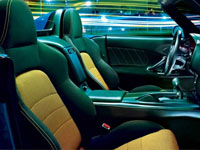
The Honda S2000 is an open-topped, two-seat roadster with a near perfect 50/50 weight distribution. The Honda S2000 uses steel body construction with the exception of the hood, which is aluminum. The body and frame are a hybrid monocoque structure. The "High X-Bone Frame" is formed by the body's high side sills, and diagonal (X) bracing underneath the body. A large central tunnel runs down the center of the cockpit. The tunnel serves as the backbone and main load-bearing structure for the vehicle, as well as a housing for the transmission and driveshaft.
The exterior styling of the S2000's body is designed to appear angular, modern and sleek. The long hood and flared front fenders create the impression of lowness and mass. High-intensity discharge (HID) projector headlights highlight the front of the vehicle, while the taillight design follows a similar theme with large, round multi-LED taillights set in clear-lens housings.
The Honda S2000 CR adds extensive aerodynamic body work that functions to significantly reduce lift and enhance chassis balance at high speeds. An underbody front spoiler and a trunk lid-mounted rear spoiler combine to lower the Coefficient of Lift (Cl) by as much as 70-80 percent depending on the roof configuration. Downforce is created by the rear spoiler when the hardtop is installed as the contour of the roof is designed to influence aerodynamics at the rear of the vehicle.

Safety Features


The Honda S2000 has dual-stage, dual-threshold front airbags (SRS) for the driver and passenger, three-point seat belts with load limiters and pre-tensioners, roll bar hoops and reinforced windshield posts. For pedestrian safety, the hood hinges and windshield-wiper pivots are designed to collapse and minimize the severity of a head injury to a pedestrian. Vehicle Stability Assist, ABS and a tire pressure monitoring system are standard equipment.
SOURCE:NETCARSHOW

READ MORE - HONDA S2000 CR 2008

Thursday, December 31, 2009

HONDA INSIGHT 2010


Honda Insight 2010


To help Honda Insight owners realize the full benefits of Honda hybrid technology, the Insight will feature a new interactive, driver-focused fuel economy enhancement technology named the Ecological Drive Assist System (Eco Assist™). Eco Assist combines multiple functions: a driver-activated ECON mode that optimizes control of the continuously variable automatic transmission (CVT), engine and related powertrain components to further improve vehicle fuel efficiency;a driver feedback function that uses an innovative speedometer display with changing background colors to provide real-time guidance to the driver on achieving higher fuel efficiency; anda unique fuel-economy scoring function using a plant-leaf graphic to provide feedback to the driver on current-trip driving efficiency and lifetime fuel-efficient driving performance.


    All Insights are powered by an advanced 1.3-liter SOHC aluminum-alloy i-VTEC engine and CVT, along with a new generation of Honda's IMA hybrid system for exceptional fuel economy and fun-to-drive performance.


    The Honda Insight's IMA system incorporates a 10-kilowatt (13 hp) electric motor and a compact Intelligent Power Unit (IPU) - recapturing and storing kinetic energy from vehicle braking and deceleration and supplying additional power for acceleration when needed. Packaging of the ultra-compact IMA battery and IPU in the vehicle's rear floor allows the enhanced utility of a 60/40 split and fold-down rear seat back.
    The Insight's IMA system has the capability to operate exclusively on electric power in certain low- to mid-speed driving conditions. It also provides for cylinder deactivation within the gasoline engine during deceleration and for engine shutoff when the vehicle is stopped. With a 10.6-gallon fuel tank, the Honda Insight delivers an estimated maximum driving range in excess of 400 miles.


    Standard safety features on all Insights include dual-stage, dual-threshold front airbags; front-side airbags with a passenger-side Occupant Position Detection System (OPDS); side curtain airbag system; anti-lock brakes with electronic brake distribution (EBD); driver- and front-passenger active head restraints and a front body designed to mitigate pedestrian injuries. All new Insights also feature Honda's Advanced Compatibility Engineering™ (ACE™) body structure, which provides improved crash compatibility between vehicles of different size and ride height, enhancing protection for Honda Insight occupants while reducing the potential for injury to occupants of the opposing vehicle in a frontal collision.


     Additional standard features on all new Insights include 60/40 split and fold-down rear seatbacks; two-tier digital instrument panels; automatic climate control; power windows, mirrors and door locks; a tilting and telescoping steering wheel and a 160-watt AM/FM/CD audio system with MP3 audio playback, an auxiliary audio input jack and Speed-Sensitive Volume Control (SVC).
    Honda Insight EX models add alloy wheels, cruise control, 6-speaker audio system with USB audio interface,

    SOURCE:NETCARSHOW.COM
    READ MORE - HONDA INSIGHT 2010
    Related Posts Plugin for WordPress, Blogger...